Spanish Republic
For Whom the Bell TollsThe Spanish Republic is both the political cause Robert Jordan serves and the threatened community his mission is meant to protect. Its presence in the novel is felt through the practical machinery of war—orders, passes, dispatches, explosives, and delayed decisions—as well as through the intimate loyalties that bind combatants to the people and country at risk. The bridge operation makes the distinction between fighting for an institution and belonging to a collective increasingly difficult to maintain: at its most urgent, the Republic is not an abstraction to Jordan but something he experiences as shared life.
Political Cause and Personal Commitment
Jordan’s allegiance grows from a conviction that the war concerns the future of people living in Spain. He understands the danger the guerrillas bring to those who shelter and assist them, but believes that their actions serve the longer purpose of making the country a place where people can live without that danger. If the Republic is defeated, he thinks, those who believe in it may no longer be able to live in Spain. His commitment is consequently neither cost-free nor uncomplicated: he recognizes that the work exposes civilians to retaliation, yet sees no harmless alternative while the war continues.
His political position is also specific rather than all-encompassing. Jordan says that he believes in the Republic as a form of government, while judging its leaders and political conditions harshly. He has accepted Communist discipline for the duration of the war because he regards it as the most effective and reasonable discipline available for prosecuting the conflict. At the same time, he tells himself that he has no politics now and imagines returning to his former life after the war. That tension leaves his allegiance grounded less in a promised political future than in the immediate obligation to the people whose lives the outcome will determine.
The possibility of a future beyond Spain surfaces in his private thoughts about returning to the United States and teaching Spanish. He wonders whether his involvement may leave him marked as a Red and jeopardize his academic work, though he also reassures himself that the consequences remain uncertain. Such thoughts do not cancel his commitment; they place it beside an imagined civilian future that the war may prevent him from reaching.
The Republic as a Military and Political System
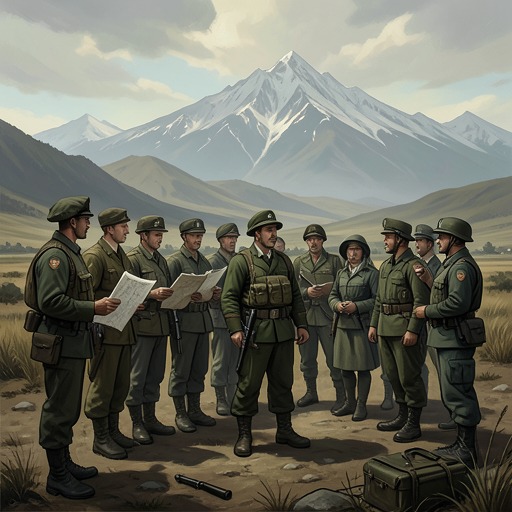
The Republic’s military effort is shown as a chain of command that cannot always translate plans into action. General Golz explains that attacks are not simply his to command: artillery and other resources must be requested, and interference can frustrate preparations. For Jordan’s operation, the timing of the bridge demolition is essential. It must follow the start of the attack, so that reinforcements cannot travel up the road before the offensive begins. The mission therefore depends on coordination between a local act of destruction and a larger operation beyond the guerrillas’ direct control.
That coordination becomes precarious when the offensive is already under way. Jordan fears that Golz may be unable to cancel it himself and that permission would have to come from Madrid; even if someone there could be reached, the delay might make the decision useless. Enemy preparations have appeared too late for him to report them sooner, and the lack of reliable, immediate communication leaves him weighing uncertain explanations for troop movements and aircraft. The problem is not a lack of individual resolve but the distance between battlefield knowledge and the authorities empowered to respond to it.
The Republic’s institutions also have to recognize and authorize people whose work is essential but whose status is irregular. On his journey with the dispatch, Andrés presents a safe-conduct pass bearing his identity and mission, along with a silk emblem in the Republic’s colors and documents sealed with the S.I.M. stamp. The officer examining him accepts that the emblem alone proves nothing and scrutinizes the pass. When the officer urges the guerrillas to enter the Republic’s territory and submit to regular military discipline, Andrés answers that he has orders to deliver a dispatch to the general commanding the Thirty-Fifth Division before a daylight attack. He asks for transport onward, but the exchange exposes the friction between local guerrilla action and the army’s preference for centralized control.
The official ideal of bringing the guerrillas into the army is not the same as their existing role. The officer dismisses their activity as guerrilla nonsense and imagines that the army should send such forces out when needed. Andrés, by contrast, treats his particular assignment and its deadline as decisive. The episode shows the Republic as a political and military structure still trying to manage armed groups whose knowledge, mobility, and methods do not fit neatly within its formal procedures.
The Bridge Mission and Collective Survival
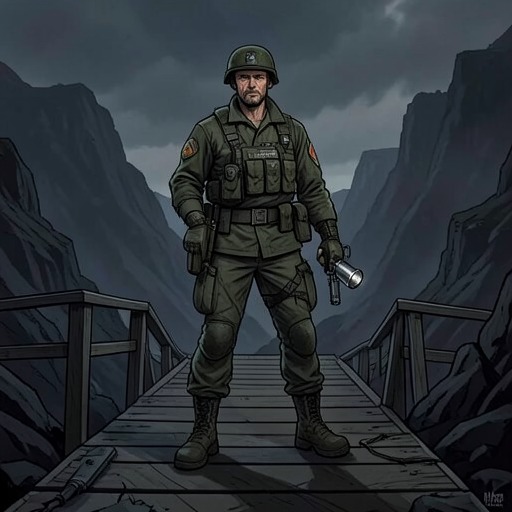
The bridge concentrates the Republic’s strategic need into a physical obstacle and a timed task. It is a single-span steel structure over a deep gorge, with a sentry box at either end, wide enough for two motor cars. Jordan studies it from the hillside and sketches where explosive charges could cut the support and drop part of the span into the gorge. He considers a carefully arranged set of charges or a rougher method using two large charges placed opposite one another. The site’s construction and position matter because the goal is not symbolic damage but the interruption of movement along the road.
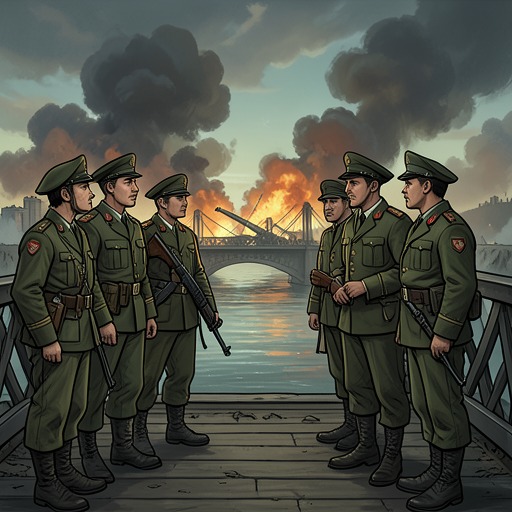
At the final stage, Jordan and Anselmo carry the explosives into place. Anselmo passes down the blocks; Jordan positions and braces them against the steel girders, asks for wedges, and secures the assembly with wire. Firing and grenades sound from the road while he works, making the operation inseparable from the fighting around it. He then moves across the bridge’s trestling to prepare the other side. The physical labor gives the Republic’s larger military purpose a concrete form: a road must be denied to reinforcements, and the charges must be held firmly enough to make that denial possible.
The work is also shared across separate positions. While Jordan handles the charges beneath the bridge, another participant holds a loop of wire and waits to complete the task. In that moment, the Republic becomes part of a felt connection among the man at the wire, the man under the bridge, the explosives, the battle, and the cause itself. The passage does not present collective belonging as a slogan alone; it gives it the structure of interdependence, with each person’s position tied to the others’ work.
For Maria, the bridge’s destruction is bound up with Jordan’s survival. As she waits with the horses, she prays for him and fears the uncertainty of not knowing what has happened. When the bridge blows, a horse breaks loose; she catches and brings it back, then hears that Jordan is all right. Her distress makes visible the personal cost hidden within the military timetable: the same action that serves the Republic places a loved one in peril and leaves those waiting with no immediate knowledge of his fate. Her thoughts distinguish the Republic’s cause from the demand that Jordan return, even as she feels unable to separate herself from him.
Failure, Delay, and the Limits of Victory
The Republic’s offensive is never presented as a guaranteed triumph. Jordan considers whether the enemy’s movements signal another major operation, questions what the Republican side has learned from earlier campaigns, and recognizes that the attack may go ahead despite warning signs. He tells himself that it is a holding attack, not a promise of immediate victory. Even a breakthrough today would not remove the larger uncertainty: the struggle could continue for years, and its wider prospects depend on equipment, outside assistance, and whether the enemy can be held in place.
His hope is conditional and collective. He imagines that foreign help and access across the frontier could strengthen the Republic, and believes that its people can keep fighting if adequately armed. But those possibilities sit beside the practical failures he has just confronted: plans can be compromised, messages can arrive too late, and the authority to alter an operation may lie somewhere beyond the battlefield. The contrast gives the Republic both resilience and vulnerability. Its people may persist, but persistence alone cannot repair every weakness in command, supply, or communication.
The bridge is ultimately destroyed, yet the blast does not erase the costs of the mission or settle the war. In the aftermath, Jordan is left with a broken leg and faces the possibility that he cannot leave with the others. He looks toward the world he has fought for and reflects that he has fought for what he believed in for a year. His sense of the Republic culminates not in a report of institutional victory but in a moment of belonging: he feels himself joined to the bridge, the battle, and the cause. The political collective has become personal without ceasing to be political.
Violence, Memory, and the People at Risk
The novel also complicates any account of the Republic as a cause that automatically makes its adherents innocent. Anselmo says that killing a person is a sin, including the killing of Fascists whom the war requires him to oppose. He has killed and expects that he may kill again, but hopes that a later life of doing no harm will make forgiveness possible. His position places moral unease inside the Republican struggle rather than outside it: necessity does not prevent violence from remaining a burden.
Jordan likewise confronts the consequences of guerrilla action for civilians. He recognizes that the bands bring danger to the people who shelter and work with them, while also believing that their eventual aim is to end that danger. Pilar’s account of violence in her village makes the costs of political conflict harder to keep at a distance. Jordan thinks that guerrillas often leave before they learn how events end: they come at night, accept shelter, do their work, and disappear, while the peasants remain to face punishment. He has heard of the harm his own side has caused, but Pilar’s telling makes that history newly immediate to him. The Republic’s cause is therefore inseparable from an unresolved question of responsibility toward the people whose lives its fighters endanger.
The novel extends this problem through stories of both Republican and Fascist violence. Pilar recounts the village crowd’s killing of Fascists and says that this was the end of the killing in her town; Jordan reflects on how completely her account made him see what he had not witnessed. Elsewhere, he considers the execution of Joaquín’s family by the opposing side. These accounts do not make the acts equivalent in circumstance, nor do they remove the political stakes of the war. They do show why the Republic’s claim to protect a livable country must be measured against what people do in its name, what its enemies do to its supporters, and what ordinary families are left to endure.
The Republic’s significance finally lies in that difficult conjunction. It is a government and an army with real organizational limits; a cause Jordan believes can protect people from a life made unbearable by defeat; and a community experienced through shared work, danger, and attachment. Its survival depends on action, but the novel refuses to let action become morally simple. Even at the bridge, where the military task is exact and the charges are firmly placed, the meaning of the cause remains bound to the lives exposed by the war and to the people who must carry its consequences.